Showing posts with label tips. Show all posts

Monday, January 26, 2009

Piracy or PvP

Disclaimer: This post is directed toward Pirates, PvP'ers and people that confuse these groups with pirates. This post is not meant as an insult or slight to any particular group.

Anyone who feels I have insulted their playstyle, play how you want. I am not insulting what you find fun in.

For those who get an idea to change their playstyle because of this post, remember who gave you the idea when I'm tackled by your fleet. :)

* * *


Many people seem to have a misconception on what a pirate is. So first, let me go over what does not necessarily make a pirate.
- Someone with negative reputation or a bounty. This is an outlaw.
- Someone that enjoys PvP, regardless of location. This is a PvP'er.
- Someone that kills ships using massive fleets usually overpowering targets or outnumbering them. These are gankers.
- Someone that kills easy targets solely to revel in the targets grief. This is a griefer.
- Someone that kills targets by guarding a gate. This is a camper... or a Nulsec Corp guard.

Although pirates may use these tactics, not everyone who uses these tactics are pirates.

So, what is a pirate?

Piracy is robbery committed without permission from a nation. As most PvP is based around killing, not robbery, most PvP'ers that are not attempting to commit theft are not pirates. Furthermore, PvP'ers that are killing targets to loot the remains may be pirate-like, but they are not committed pirates.

How can you tell a pirate vs. a PvP'er?

Piracy in the Caribbeans was very close to a democratic environment. The Captain remained as long as he is trusted (or feared) by the crew. If the crew felt the captain was no longer worthy or if the Captain died they would vote a new captain into place (Black Bart became a pirate by force and became captain by vote when the previous captain died)

Pirates had two flags they used. The most common flag was the black and white flag. This flag designated that the pirates would take prisoners (or allow those that surrender free). When the target is generally hostile (naval ships) or the vessel is part of a group the pirates don't like (British East India Trading Company) the pirates will use the black and red flag. This flag means "No quarter, none expected" (all will be killed and the pirates expect the same in return), this flag is flown normally because the target is either a group that has broken "pirate code" or to ward away targets with little value (naval vessels are normally not worth combating due to it's massive firepower and little cargo).

PvP'ers in contrast are closer to the concept of murderers. They would "in essence" only fly the black and red flag. Earnings are gained only through collecting undamaged items found in the wreckage of ships instead of attempting to give terms to the target that is more beneficial to both the pirates and the targets.

What does this have to do with piracy in Eve?

Proper piracy means thinking less like a murderer and more like a corporation. You are attempting to get as much profit as possible with as little cost as possible. So a good pirate is not looking for a kill, but an easy target. The idea is to get the most profit by having the target surrender and provide for the pirates demands vs. having their ship and potentially their cyberware destroyed. This gives the pirates their profit without the potential loss from a fire-fight. Also, this means the pirate can ask for something less tragic from the target to entice a non-combative outcome.

Therefore, piracy is more about blackmail than PvP. Remember this the next time you call that ganker a pirate.

Monday, January 19, 2009

MMOGconomics 3: Player Interdependency

In this installment, we'll discuss how different players and play styles effect others in an economic sense.

First lets start where it all begins: Gatherers
Miners/Scavengers/Researchers gather materials that are the building blocks of the major items. Miners and scavengers gather raw components and Researchers create the blueprints for the final product.

Next is the creators of the products: Builders
Ship Builders/Module Builders/Riggers use the raw materials to create the final products used by all pilots.

And our final group of players: Consumers
Combat Pilots use the Builders items to earn money and in turn buy better items.

So, how do these groups interconnect?

Gatherers and Builders
The most obvious connection. Gatherers sell raw materials to Builders and Builders sell gathering items to Gatherers (making gatherers Consumers as well)

Builders and Consumers
Again very obvious. Builders sell completed materials to Consumers and Consumers give Builders ISK for more raw materials.

Simple, right? Now lets look at the last connection within this web.

Consumers and Gatherers
Depending on the Consumer, this group will either protect or attack gatherers. This will cause the worth of the materials either go up (harder to get because of combat) or lower (easier to get because of protection).

So let's go through a few scenarios to get a feel as to how these connections effect the market.

Scenario Base
- Several miners find some prime real estate to mine Zydrine. An item needed for many items to be made.
- The price dictates how many can be bought by the Builder that will be used to make a line of Thoraxes.
- The builder prices his Thoraxes to earn money back from expenses for the raw materials and to make some profit for himself.

Basic, right? Let's start the first chain of events:

Scenario #1
- The Thoraxes are bought by pirates (Consumer), and begins to terrorize Zydrine miners.
- The miners increase the price of Zydrine to pay for mercenaries (Consumer).
- The price for Thoraxes goes up to compensate for the rise in Zydrine.
- The pirates fight the mercenaries.
- The pirates and the mercenaries have to pay more for new Thoraxes.

So, because pirates attacked miners all consumers inevitably had to pay more for their new Thoraxes.

Let's change who buys the Thoraxes and see the results.

Scenario #2
-
The Thoraxes are bought by a NulSec Corporation (Consumer), and begins a NulSec war creating more demand because of ship losses.
- The price of Thoraxes goes up as demand does to afford more Zydrine.
- The price of Zydrine goes up as demand does.
- More miners try to mine Zydrine causing supply to increase and decreasing the price of Zydrine.
- The price of Thoraxes drops with the price of Zydrine.

Here is a basic example of economic rebound caused by an increase in demand. Obviously, a drop in demand (the NulSec War ends) would rebound the opposite way with a drop in price and less miners mining. How about the recent "Eve Economic crisis" regarding dupe* raw materials?

Scenario #3
- Several miners learn how to dupe* Zydrine.
- An increase of Zydrine enters the market dropping the price dramatically.
- Because people who do not exploit Zydrine are not getting a fair price they mine other materials, increasing the price slightly.
- As more Thoraxes can be made cheaper, the price drops as well.
- CCP discovers the dupe* process and begins banning and cleaning up the exploit.
- The excess Zydrine is removed from the market leaving very little supply (all the miners left remember) exponentially increasing the price.
- The price of Thoraxes jumps in line with Zydrine.
- More miners move in to mine Zydrine. This reestablishes the Zydrine market and lowers the price.
- Thoraxes drop in relation to the Zydrine.

In Closing
Markets are, by default, a reestablishing system. External forces can destroy a market, but markets will reestablish themselves as long as the basic economic rules remain. Also, events caused by any member of the system, including pirates and CCP, effect the economy. The economy also inevitably creates a chain of events that will effect every player.

So remember, regardless of your position in the game, the economics of your actions will effect you.

*Duplicate

Monday, January 12, 2009

MMOGconomics 2: Money Sinks, Spawn Time and PvP

In this installment of MMOconomics, we'll discuss how artificial resource maintenance can stabilize MMO economy.

Money Sinks
To decrease flowing currency (currency is a resource too), developers add items that are purchased from NPC's. Giving the NPC's money decreases the amount in the player base and effectively removes it from circulation (Eve: Skill books, WoW: Mounts, ect.). In Eve, items are bought by NPC's as well to maintain their worth. Other methods similar to this are repair costs.

Spawn Time
In order to decrease resources from being constantly fluxing in, games limit the amount of resources are obtainable at a given time. Although this does not make resources infinite, it does make only a finite available for a given period of time. This artificial limit decreases overall influx of resources making the supply stable.

PvP
PvP is another excellent way to remove resources from the market. If a player's ship is destroyed, the ship and all unlootable items are removed from the market. This also forces combat players to constantly input more into the market then just getting upgrades.

Monday, January 5, 2009

MMOGconomics 1: Economics 101 and MMO's

A lot of individuals seem confused how MMO's and economics work. A lot of people have very odd questions that seem to be answered through basic economics. So over the course of the next three weeks I plan to go through some MMO economics and how that applies to the average MMO player. Hopefully, these three installments will open more people's eyes to the effects of economy and the cause & effect systems surrounding it. Make a note that most of these apply to any MMO and not exclusively Eve Online.

This week, we'll go over basic economic theory and how that applies and doesn't apply to MMO's.

Basic Economics

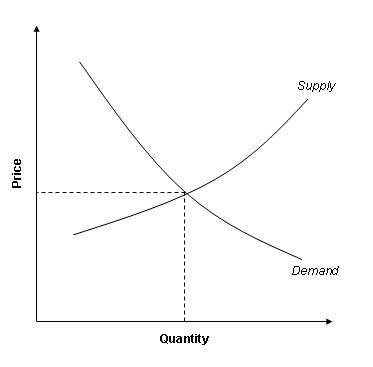
All economics is based off of the basic concept of supply and demand. The more supply that is available the less an item is worth, also the more people demand an item the more it's worth.

Image credited to www.mikeonads.com

This basic concept has one important keynote to keep a collapse of the system from occurring:

There is only a finite amount of resources.

In reality, there is always a finite amount of everything and therefore this rule will always be maintained.

MMO Economics
In MMO's, this law of economics is broken by default, because every resource would inevitably deplete leaving nothing for players. As such, other artificial methods are implemented to remove resources from the player's and the game. Usually referred to as "money sinks" and "spawn time", MMO's require these artificial methods to maintain an unbroken economy in the game itself.

MMO Resources
In every MMO, some resources are broken. Here is the list of every common MMO resource and it's status.

Construction items - Items used to build useful items and tools are
commonly infinite. There will always be a place to mine or wreak/body to use a skill to remove resources that can be used to make useful equipment.

Currency - Due to missions/quests, bounties, ect. there is an infinite amount of monetary gain available.

Time - This is one of the key resources that is not infinite.

Effort - Human effort also is finite. As such, an infinite amount of ore may be available, but human effort limits the amount of usable resources.

MMO's utilize time and effort (as finite resources) and create artificial economic controls centered around these items to stimulate the worth of these items.

Saturday, December 13, 2008

Types of combat

There are so many types of combat that most people with find a nice preferred niche some where in combat space. The following are the basic positions in fleet combat. Smaller scale combat requires less people to perform these same jobs.

The Tackler
Other MMO equivalent: Crowd Control
The individual tasked with keeping an enemy from escaping. A tackler's purpose is slow the target, make him unable to warp, disable microwarp and generally making the target unable to escape or effectively maneuver.

The EW Specialist
Other MMO equivalent: Debuff
The individual tasked with removing enemy combat capabilities. An EW specialist removes the enemy's targeting capabilities, and other attack mechanics.

The Drainer
Other MMO equivalent: Debuff
Capacitor power is life, and a Drainer removes that power from the enemy. Without capacitor power ships lose the ability to attack, repair and actively protect themselves leaving them vulnerable.

The Damage Dealer
Other MMO equivalent: DPS
A damage dealer give maximum unadulterated damage to the target shredding through any protection through shear destructive power.

The Tanker
Other MMO equivalent: Tank
A tank wades through the massive damage keeping targets occupied to allow other weaker ships to disable and destroy the enemy.

The Logistics Specialist
Other MMO equivalent: Healer/Buff
Remote repair and assistance vessel used to decrease losses in a fleet by supplementing the fleet.

The Drone Carrier
Other MMO equivalent: Utility
Able to quickly modify a supplemental job by swapping drones allows drone ship the ability to supplement any other position in a fleet.

The Recon Specialist
Other MMO equivalent: Stealth Class
Recon cloaking technology allows fleets to assess combat requirements before combat takes place allowing proper planning to complement any foe.

Friday, December 12, 2008

Beginning Professions Part 2: Non-Combat

Here's a link to all the professions in Eve today.

Non-combat professions are either used to supplement income for combat pilots or individuals solely work on this equipment for large monetary gains. In this post we will discuss starting non-combat professions.

Non-Combat Related Professions

Miner
Ever seen the rings of an asteroid and seen ISK slowly umbering through space? Or seen the wonders of profit rising while reprocessing ore? Then you may be the next New Eden Miner. Miners toil endlessly looking for rare ores to process valuable raw materials. Materials that are the backbones to construction to Eve ships, weapons, modules and fuel. Miners get huge rewards from mining various sectors of space.
Specialization: Non-combat
Level: Beginner
Related to: Mining
Key skills: Mining
Related professions: Manufacturer, Hauler
Even the starter frigate is a metal object about the size of the Eiffel Tower, and thousands of these ships get destroyed every single day. All these metals come from somewhere, and the miner is responsible for the majority of all raw minerals sold onto the market.
Mining ranges from solo frigate mining in 1.0 asteroid belts, through organized gang strip mining of whole belts, with dedicated mining cruisers, haulage and security cover, right up to deep 0.0 Alliance-run expeditions for rare minerals, along with associated blockade running to bring them to market.

Courier
Everyone needs something, and items don't move themselves in magical bank teleportation networks (like some MMO's). This means someone has to do it, and someone is willing to pay someone else to do it for them. In ancient earth, these bastions of the roads, move goods all over the planet. Now with spaceships, this necessary service moved to the stars as well.
Level: Beginner
Related to: Courier missions, Mining, Trade
Key skills: Spaceship Command, Navigation
Related professions: Miner, Trader
Transport trade goods or other items of interest (modules, minerals, etc.) from one section of the galaxy to another in search of profit.
A bulk courier is known as a hauler. Though a character can specialize in piloting Industrial Ships, you will likely want basic hauling skills at some point in your career. For more information, see the basic section of the Hauling Guide.
Note that some couriers specialize in transporting small expensive items; those will often employ frigates or interceptors instead of industrials.

Trader
The time honored tradition of middleman economics is alive and well. Unlike transporters, traders buy items in locations where they're made and move them to where they're more needed, then selling them at a huge profit margin. Traders use guile to get the best deals and the most discounts and trading them to those who can't get to them for big payoffs.
Specialization: Non-combat
Level: Beginner, but intermediary highly recommended.
Related to: Trading, Economy of EVE
Key skills: Trade
Related professions: Investor, Courier
The EVE regional markets are an incredibly complex affair, and an excellent source of income for those who can work them well. Thousands of worlds, all with supplies and demands, and all relying on the Capsule pilot to join the dots...for a price of course...
Trading takes three main markets in EVE; the NPC Trade Goods Market, where margins are smaller, but more dependable, the Player Equipment Market where competition is firece, but ignorance can be capitalized on, and the Contract (former Escrow) Market, where pretty much anything can and will go. At it's simplest, trading is just buying something cheaply at one station, and taking to a place where they're paying more, but soon develops into a complex game of longterm planning, three month buy orders and logistical organization.
Scavenger - Many people see wreaked ships as space debris, useless. Scavengers see easy profits. Slightly damaged parts and bits can be refurbished and installed to modify existing ships. These items are in high demand and many combat pilots use this to get a little extra out of their 'ratting and missions.

Manufacturer
The architect of New Eden. These are the individuals that every pod pilot must pay homage to as these are the laborers that build what pod-pilots fly.
Specialization: Non-combat
Level: Intermediate to advanced
Related to: Manufacturing, Science And Industry
Key skills: Industry, Science
Related professions: Scientist, Investor
With the galaxy such a turbulent place, and more and more new pilots entering the Capsuleer community, the demand for space-based manufactured items is ever increasing, from a single scout drone, up to the largest Titans and Outposts, manufacturing is everywhere.
Day to day manufacturing of smaller objects, ammunition, ship modules and smaller ships, largely takes place in starbase factory slots, on short-term lease arrangements. Capital and permanent structures on the other hand tend to be constructed in space, using the facilities provided by POS Towers. Manufacturers work with both these methods, and are often also responsible for the underlying supply chain of raw materials too, and the distribution of finished product.
Many combat pilots with no primary interest in large-scale manufacturing still learn the basics of the process, to allow a degree of self-sufficiency in small-scale ammunition resupply from reprocessed loot, or to channel reprocessed junk-loot into one-run BPC 'hobby project' Battleships for resale.

Scientist
Specialization: Non-combat
Level: Intermediate.
Related to: Research Agents, Science and Industry
Key skills: Science
Related professions: Manufacturer
The technologies involved in designing, building and operating starships are bewildering to say the least. But even the most complex and advanced capital ship began life as a sketch on someone's drawing board, and such designs are rarely perfect on their first version.
There are two types of scientists. Some work with inventions, creating new blueprints; others refine existing Blueprints to increase the time and mineral efficiency of the existing design. They also make blueprint copies, allowing others to manufacture limited runs of the original product.

Salvager
Salvaging is the extraction of salvage materials from ship wrecks which are then used in the construction of valuable ship rigs.
Specialization: Non-combat
Level: Beginner
Related to: Mining
Key skills: Salvaging, Jury Rigging
Related professions: Manufacturer, Hauler

Revelations introduced what would be considered two sub professions. Though not actually requiring the mining skill as a pre-requisite, their usage and methodology clearly define them as a branch of the mining profession. This profession tends to work out best with combat professions as it requires wreaked ships to process.


Thursday, December 11, 2008

Beginning Professions Part 1: Combat

Here's a link to all the professions in Eve today.

Because most MMO players want to kill and blow things up first and foremost, let's talk about the starting combat professions right now.

Combat Related Professions (These are professions, not types of combatants. Types will be covered later)

Soldier - The four main factions of New Eden all have military forces that can always use one more pod-pilot. These mission are dangerous and the opposition won't like what you're doing, but the pay is good.
Level: Intermediate
Related to: PvP, Factional warfare
Key skills: all combat related, PvP specialization, some mission elements
Runner - People need things done (including NPC's), and runners are the ones to get them taken care of. The pay is better the more you're liked.

Pirate - Some people are content following the rules of society. Others would rather not do the hard work. Pirate prey on the weak and unprepared. They earn their money through theft and slaughter, but the risk of being caught is great.
Specialization: Combat
Level: Beginner
Related to: PvP
Key skills: all combat related
Related professions: Anti-Pirate, Bounty Hunter, Mercenary, Mission Runner, Miner,
Every society has its criminal Element. Pirates represent that facet of society. Ruthlessly exploiting combat prowess to extort, ransom, or simply annihilate other capsuleers for profit or pleasure.
Pirates use varying tactics depending on the location, situation, and their skills. Above all, a pirate must be fearless, and willing to make sacrifices in the name of carnage and destruction.

Runner - People need things done (including NPC's), and runners are the ones to get them taken care of. The pay is better the more you're liked.
Specialization: Combat
Level: Beginner
Related to: Agents, Missions, PvE
Key skills: all combat related and Social
The many NPC Factional Corporations in EVE all have their own interests in space. When their own forces are occupied elsewhere, or when a job needs doing that requires a discrete outsider, they use their Agents to hire help from the Capsule community, and authorize large payments for results.
Agents missions form the majority of the PvE combat content in EVE, and are a good way to get stuck into to some on-demand starship combat. Agents also offer courier missions, and some conduct research, with the eventual aim of giving out valuable blueprints for production.

'Ratter - There are just as many 'rats (NPC's) in High security (1.0-0.5) space as there are civil folk. A 'Ratter takes care of the 'rats occupying high sec space, places where the factions and CONCORD can't find. There are some nice finds in some of these "complexes" and the 'Ratters profit from them.
Specialization: Combat
Level: Intermediate
Related to: PvE
Key skills: all combat related
Similar to runners, ratters do PvE combat, but unlike runners payout comes in the form of high-end gear and equipment from enemies. The payoff comes from effectively free upgrades and money from the sales of the found equipment.

Anti-Pirate - Low security (0.4-0.1) space is a hive for pirate (PC's) scum and the Anti-Pirate wouldn't have it any other way. Profiting from the pirate's spoils and bounty's may not be the method for these people's ideology but it certainly helps.
Specialization: Combat
Level: Beginner possible but intermediate to advanced highly recommended.
Related to: Pirates. PvP
Key skills: all combat related, PvP specialization
Related professions: Bounty Hunter, Pirate
Some Anti-Pirates consider themselves driven by ideology, not bounties. In any case, for all practical intents and purposes, see Bounty Hunter profession. For the rest, read on :)
The Anti-Pirate Profession bears enormous risks. Why is doing the right thing always so damn difficult. Why is it that so few of us find the courage to fight for the unpunished injustices of our universe? Should I fail at my task, the tragedy will not be in my own death, but in the fact that my prey will continue to live out their wretched, despicable existence.
“It is said that cowardice lurks behind power; that every tyrant fears the day when others learn where the source of real power lies. What better way for a tyrant to hide that truth than by claiming absolute authority and threatening absolute ruin to those who question them!"
The art of war is a matter of life and death, a road either to safety or to ruin. Hence it is a subject of inquiry which can on no account be neglected.
"I have high hopes of smashing my name into history so violently that it will take a legendary form, even if all the books are destroyed. That goal, is the real goal as far as I am concerned." ...Geminisceptre
Known to many in the Galaxy as the self proclaimed vigilante police force of the Eve Universe, the Anti-Pirate roams the stars seeking to crush his prey, Pirates, as they have so mercilessly crushed theirs so many times before. For many who enlist in the Anti-Pie ( as called by many ) profession they are called to it like a moth to the flame, for just as the old days of our ancient past, Their must be Cowboys to battle the Indians. The anti-pirate profession is perhaps one of the hardest of the Eve Universe, there are no medals, there is no recognition, there is nothing but death. Unlike Bounty Hunters, Anti-Pies seek not the money on the heads of their prey, they seek only the knowledge that deaths of all Pirates are as painful and slow as that of their unwary victims before them.

Bounty Hunter - Hunting down the bounties is the bread and butter for these people. Their sole purpose in life is to collect the bounties of criminals.
Specialization: Combat
Level: Beginner possible but intermediate to advanced highly recommended.
Related to: Pirates. PvP
Key skills: all combat related, PvP specialization
Related professions: Anti-Pirate, Pirate
Bounty hunters hunt down and kill other players that have bounties on their heads. For an ideaological version of this profession, see Anti-Pirate.
A locator agent that can help locate the targets is useful; bounty office on stations is another useful tool.
Nonetheless most bounty hunters agree that its hard to make any living out of bounties, and instead of seeking specific individuals they roam the same low-sec systems as their pray.
This profession requires very good PvP combat skills as the people being hunted are mostly pirates that have good knowledge of PvP and how to evade people who are after the bounties on them. That said, some bounty corps recruit newbies and train them on 'no implants/cheap frig/no named modules' policy. Expect to die. Often. Although that holds true even for experienced PvPers, too :)

Corp Fighter - Out in No Security space (0.0) law is what you make it. Corporations flock here to get a piece of space, to grow, and to become a powerful force skirting the factions. Large Alliances battle relentlessly to gain more ground and gain prominent control of the rim of New Eden.
Specialization: Combat
Level: Intermediate
Related to: Corporations, Alliances, PvP
Key skills: all combat related
Related professions: all combat related
People in a corporation who are soldiers dedicated to that specific corporation and it's alliance.

Mercenary - Soldier of Fortune. Mercenary's work for the highest bidder. Don't be fooled, even though these group will do anything for the right price, failure to pay can become a death sentence.
Specialization: Combat
Level: Intermediate
Related to: Corporations, Alliances, PvP
Key skills: all combat related
Related professions: all combat related
People who are hired to kill. Normally by a corporation or an Alliance which is a major player in Alliance politics.

Wednesday, December 10, 2008

Learning Skills Part 3: New Player Skill Plan

Skills represent what you can and cannot do and how well you are at doing them. As such your skills will dictate your learning progress speed for professions.

Info on Attributes and Skills

Today I will talk about skill Planning for new players.

When a player begins the game there are certain skills that are necessary for all pilots to learn to succeed and become better. Regardless of your intended career or ship these skills will assist you in your goals.

Learning (category)
All the skills in the learning category increase your learning speed. As such any of these skills are inevitably useful. Upgrading this early, eventually helps your learning speed more than working on it later.

Electronics
Increases your CPU performance allowing better modules to be added to your ship.

Targeting
Increases the number of targets you can simultaneously lock on to.

Engineering
Increases your powergrid performance allowing better modules to be added to your ship.

Energy Management
Increases your capacitor power increasing your ship's effectiveness.

Energy Systems Operation
Increases your capacitor recharge rate increasing your ship's effectiveness.

Mechanic
Increases your structure hit points increasing your ship's survivability.

Navigation
Increases your velocity increasing your ship's maneuverability.

Afterburner
Increases your afterburner charge increasing your ship's maneuverability and speed. Also effectively decreases your capacitor usage by afterburners.

Warp Drive Operations
Decreases your capacitor usage by warp.

Spaceship Command
Increases your agility increasing your ship's maneuverability. Also a requirement for various ship types.

Here's a good outline resource for skills.

Tuesday, December 9, 2008

Learning Skills Part 2: Starting Skills

Skills represent what you can and cannot do and how well you are at doing them. As such your skills will dictate your learning progress speed for professions.

Info on Attributes and Skills

Today I will talk about starting skills.


Starting skills for all individuals are based on:
Race
Career
Specialty

As such take this into account when you look at your character creation choices before choosing a career path. As this list is very long I have linked a chart to look at them here+.

Here are the base categories of skills and their purpose.

Corporation Management
Corporation management skills are not nearly so diverse as, for instance, gunnery, but play a vital role in organizing players (and NPCs). There are two separate root skills: Corporation Management, and Anchoring.
Corporation Management
Corporation Management, and the advanced versions of the skill, limit the number of members allowed in the corporation.
Anchoring
This skill allows the use (in regions of security level 0.7 and below) of secure containers and deployed warp disruptors.


Drone**
These skills permit, and enhance, the pilot's ability to command and control drones.

Electronics* ^
Electronics is the field of sensors and computer systems, both offensive and defensive. The vast majority of this category deals with targetting: - improving yours (or your friends') - degrading theirs.

Engineering*
Engineering skills center around the powergrid and the shields, and things affecting either one.

Gunnery**
These are all skills influencing direct fire weapons, as opposed to launched ones (missiles/rockets).

Industry
The Industry category is a curious beast, as it has two base skills: Mining, and Industry.
Mining
The mining-based skills are focussed directly on extracting resources including ore and ice.
Industry
The Industry-based skills are again divided, into skills that help production, and skills that reduce waste in refining.


Leadership
Leadership skills are all about providing bonuses to your team mates.

Learning*
Learning is a skill tree that contains skills that advance your skill learning by increasing attributes and lowering learning time. Training these skills can both be very useful and yet absolutely useless. But hopefully you will manage to balance them out. Note that if you max out all skills it will take years for you to gain any time.

Mechanic*
Mechanic skills break down into several categories: skills related to repair systems, including remote repairs, skills related to modifying a ship: rigging, and armor hardening, skills related to construction of new ships, or in tearing apart old ones.

Missiles**
As might be guessed by the title, skills in this category deal with handling launched weapons, as opposed to direct-fire weaponry, or autonomous free-flying devices.

Navigation*
These skills all influence the performance of your ship in maneuvering, both tactically and strategically.

Science*
The Science skill category centers on research, but it has a few tie-ins with other disciplines as well. Research aside, science skills are involved in advanced mining and processing techniques, advanced survey abilities, in the use of jump clones, and use of cybernetics.

Social
Social skills are all about getting more out of your missions (money, influence, etc.).

Spaceship Command*
Almost all skills in this category provide a bonus to piloting ships of that type only. The bonus provided depends not simply on the ship category (IE Amarr Frigates), but on the particular ship involved (IE Tormentor vs Crucifier). Beyond this ship-by-ship performance increase, skills in this category primarily serve to restrict access to ship types, as noted by the number and layering of prerequisites.

Trade
The trade skills category improves your ability to conduct trade, both on the open market, and in creating individual contracts.
Trade
Trade is what makes the entire economy operate. Increasing the number of allowed sell oder up to 300.
Contracting
Contracting is the means whereby a player can establish an auction, post courier tasks, create secured (or unsecured) loans, make offers to swap items, and other forms of formal contracting.


* -
Common criteria for all pilots. All pilots will work within these fields regardless of intended profession or play style.
** - Combat Skills.
All pilots should work some degree in these fields for a defensive measure.
^ - Combat Related. Some of these skills are related to some form of combat or type of combat.
+ - Credit to Tiberyya Za for this great resource.

Monday, December 8, 2008

Learning Skills Part 1: Planning Attributes

Skills represent what you can and cannot do and how well you are at doing them. As such your skills will dictate your learning progress speed for professions.

Info on Attributes and Skills

Today I will talk about Planning your skills starting with attributes.


Note: Attributes affect your training times for skills. Nothing else.

Attributes are easily categorized based on the professions you would like to do and common items that all pilots should know.


When you create a new character the following steps will effect your base attributes:
Bloodline (indirectly race because bloodlines are race specific)
Ancestry
Attributes (5 attribute points you control)

Also the following steps will effect your starting attributes do to learning skills:
Career
Specialty

Intelligence
Primary Attribute for: Electronics*, Engineering*, Mechanic*, Navigation*, Science
*
Secondary Attribute for: Industry, Learning, Social

Perception

Primary Attribute for: Drones, Gunnery, Missile Launcher Operation, Spaceship Command*

Secondary Attribute for: Navigation*

Charisma

Primary Attribute for: Leadership, Social

Secondary Attribute for: Corporation Management, Trade

Willpower

Primary Attribute for: Trade

Secondary Attribute for: Gunnery, Leadership, Missile Launcher Operation, Spaceship Command*

Memory

Primary Attribute for: Corporation Management, Drones, Industry, Learning*

Secondary Attribute for: Electronics*, Engineering*, Mechanic*, Science*

* - Common criteria for all pilots. All pilots will work within these fields regardless of intended profession or play style.


Wednesday, December 3, 2008

Resources Listing

Here is a list of exceptional resources for both new and experienced pod-pilots alike

EveMon - Eve Monitor Program (Windows Program) keeps an offline monitoring of your characters Skill progress. An excellent resource with a built in skill planner and many other great features.

EFT - Eve Fitting Tool Program (Windows Program) allows you to loadout various ships prior to spending hard earned ISK on useless items.

The Eve Blog Pack - The Eve Blog Pack (Web Blogs) is (again) an excellent source to learn from experienced pilots and should be recommended reading for all pilots.

BattleClinic - BattleClinic (website) is another very useful site. One of the features I like is their online-loadout tool that can be critiqued by other pilots. Also includes plenty of guides for the less than knowledgeable.

EveWiki - Eve Wiki (Wiki Website) has every thing you need to know about mostly anything in the game. It has been mentioned that the site is generally biased toward Band of Brothers alliance, but honestly it's very informative.

GoonWiki - Goonfleet Wiki (Wiki website) is obviously biased to Goonfleet, but again the open segments have excellent information. Regardless of your opinion of them they give some smart advice.

Eve Tribune - Eve Tribune (Website) has a lot of current going on in New Eden and has good articles on what's new in-game. This has also been accused of bias, but information is information.

Updated Resources:

Eve Agents - Eve Agents (Website) finds agents for you using various useful filters like level, corperation and minimum influence.

NewCharSkills - New Character skill chart (Excel/Adobe) shows all standing possible starting skill sets for any new character type.

10 things a new pod-pilot should know.

To continue my current ramblings (that and Jin's doing boring L1 quests for rep right now so she can finally get the bubble wrap off her cruiser) about what a fresh pod-runner should know about space and New Eden. Here's a bit more of my newb knowledge for you.

Ten Things to be aware of when flying in New Eden.

1) "Anything that can go wrong will go wrong" -Murphy's Law. Bad things will happen when you least expect it. Always have contingincies and always be prepaired.

2) You are safe in a NOS (NPC owned station), but no where else. Hi security space (noted as 1.0 - 0.5 security status) is safer then Low security (0.4 - 0.1) or No security (0.0), but you are not safe. Players and NPC's can and will target you and can kill you.

3) CONCORD will punish the unlawful, but they are not protectors (see rule 1 and 2). CONCORD is not a method to protect yourself in space and they will not save you before a pirate can kill you.

4) Never use autopilot (see rule 1 and 2). Auto pilot is not only slower than manual (Auto pilot does not warp to 0), but can be fatal if a pirate sees you. Also auto pilot is pretty noticable to a trained eye. Most pirates have very trained eyes.

5) Trust no one. Question assistance from people who wish to help you. Question people helping you for no reason. Know the motives of others before you agree to anything.

6) Never fly what you are not willing to lose or able to replace (see rule 1, 2 and 3). I've mention this before. Don't dump all your ISK into something that will possibly end up as space dust tomorrow. And get insurance! Max coverage recommended!

7) Bigger is not better (see rule 1). Larger ships can do massive damage, but train so slow that smaller ships can usually avoid being hit altogether. So, do not overestimate yourself stronger in larger ships. Don't overlook or ignore small ships.

8) Raising skills past Level 3 and 4 can take days, so only raise them to a useful level. Getting the last 2% bonus in some skill is generally not worth the days of training time required unless there are other benefits (unlocking advanced skills, ability to use Tech II gear/ships). Do your research and don't waste time on a skill unless the gains are worth the time invested.

9) Always be learning a skill. Even if it's not a skill you need now investing 8 to 16 hours that you are not playing in a long skill can assist you in overall abilities. Furthermore, you can swap to shorter skills while you're playing then go back to where you left off in the long skill when you log.

10) The game is entirely based off of Risk vs Reward and Fun is a ligitimate reward. Even with rule 2, pod-pilots continue to explore New Eden, because they are doing what they like. So find your niche, mitigate your risks, and reap your rewards.

Tuesday, December 2, 2008

To Begin with...

I generally have two major outlooks when it comes to an MMO that of the player and of the Player Character (PC). As such (and because I intend to keep them unique), all player related information is italicized and PC will not.

So, welcome to New Eden as I see it, a new player. Eden is HUGE, and can be very hard to grasp in the first few days. So I will start with what I've learned in Eve so far.

1) This game will be overwhelming for the first few days. Be patient and you will learn the rules of space. This game has a 14 and 21 day trial for a reason. Make use of it in understanding the game.

2) There is no levels in the conventional sense. Getting better is based on learning skills and improving them over time (real time. not xp or game time). As such alway be learning a skill and learn long skills (over 8 hours) when you're sleeping/working/at school to get the most out of it. Also, if you switch skills before you finish it will save how far you got and will continue where you left off when you start learning it again.

3) Get a Space-Daddy. Get a friend, a trustworthy Ally, or a helpful starting corporation. Getting someone to help you through the beginning, is infinitely better than trying to figure it out on your own with Rookie Chat as your only life line. In the USNavy (real US Navy), they refer to this coach as a Sea-daddy.

4) Do the Tutorial. Do it. It's there for a reason. If your question could have been explained by the tutorial you will likely be ridiculed. Also, you get a better ship and some decent money doing the tutorial.

5) Don't let yourself get bored. This game is based on what YOU want to do and will not direct you. If you get bored then do something more entertaining.

6) Learn what you want to. The Learning skills increase your speed at learning other things, but is boring. My suggestion is to learn what you want to until you know you like the game. Once you've decided that you want to continue, move to these skills (except charisma) to 3 or 4 (this will take one or two days) then get back to fun stuff. When you're in a cruiser and you have some money (or if your space-daddy is willing to front you some) get the advanced skills and learn them to 3 (4.5M ISK each and two days of learning). Eventually, you'll move them up but these numbers will be excellent for now.

7) You will lose your ship. Maybe not today or tomorrow, but eventually you will lose your ship.

8) Don't fly what you're not willing to lose. If you can't afford to replace your ship. Don't fly it till you can. See #7. Preferably you shouldn't fly what you can't replace five times.

9) "A smart man learns from his mistakes. A wise man learns from the mistakes of others" - Mark Twain. Learn from others mistakes and successes now, before you are presented with the same situation later. http://www.crazykinux.com/2008/06/eve-online-blog-pack.html

10) Have fun. If you aren't having fun, you're playing the game wrong.